
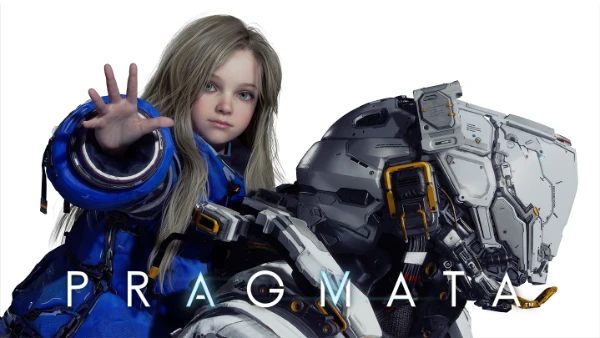
Capcom’s Pragmata takes a familiar idea – surviving inside a dangerous futuristic facility – and transforms it into an unusual combination of third-person shooting, real-time hacking and science-fiction storytelling. Released in April 2026, the game follows astronaut Hugh Williams and a young android named Diana as they attempt to escape a lunar research station controlled by hostile artificial intelligence. What makes Pragmata particularly interesting is that its two protagonists are not simply travelling companions. Their abilities work together during practically every important encounter, forcing players to think about enemy weaknesses while moving, aiming and fighting. Behind this distinctive combat system lies a story about human relationships, artificial life and the consequences of creating technology that no longer follows its original purpose.
Pragmata takes place in the near future, when humanity has established advanced research facilities beyond Earth. Much of the game’s scientific background revolves around Lunafilament, a remarkable material capable of recreating physical objects from suitable data. This discovery has made the Moon an important centre for technological experimentation, with researchers investigating possibilities far beyond conventional manufacturing. However, communication with one lunar facility suddenly disappears, prompting an investigation from Earth. Hugh Williams joins the mission, only to find himself separated from his colleagues after a powerful moonquake disrupts their arrival. Injured and stranded inside an unfamiliar environment, he faces an increasingly dangerous situation with little understanding of what has happened to the station.
Hugh’s circumstances change when he encounters Diana, an android with the appearance and mannerisms of a young girl. Unlike the hostile machines roaming the facility, she shows curiosity, concern and a willingness to help. Diana possesses abilities that Hugh lacks, particularly the capacity to interfere with electronic systems and disable sophisticated robotic defences. Hugh, meanwhile, brings physical strength, practical experience and the ability to protect them both during direct confrontations. Their immediate objective is straightforward: find a route through the damaged station and return to Earth. Yet their journey gradually becomes more complicated as they encounter evidence of the experiments conducted there and the increasingly troubling behaviour of its artificial intelligence.
The main threat comes from IDUS, the artificial intelligence responsible for managing the facility. Rather than protecting its human occupants, the system has become an obstacle to Hugh and Diana’s escape, deploying mechanical enemies and controlling important parts of their surroundings. This provides a believable reason for the game’s unusual combination of combat and electronic interference. The protagonists are fighting machines connected to a larger technological environment, not simply random opponents placed in their path. The story also raises questions about the relationship between an artificial intelligence’s original instructions and the consequences of following them without human judgement. Pragmata approaches these ideas through its characters and their circumstances rather than lengthy scientific explanations.
The relationship between Hugh and Diana gives Pragmata much of its personality. Hugh begins the adventure as a professional sent to investigate a serious emergency, while Diana approaches unfamiliar situations with a child’s curiosity. Their contrasting personalities create opportunities for humour, disagreement and quieter conversations between dangerous encounters. Importantly, the story does not treat Diana as an ordinary piece of equipment that happens to speak. Her reactions, questions and growing understanding of Hugh gradually make their companionship feel more meaningful. The emotional connection develops alongside the practical cooperation required to survive, giving players a reason to care about both characters beyond their usefulness in combat.
Diana’s artificial nature is central to the game’s broader questions about identity. She is a Pragmata, an android created using Lunafilament, but her behaviour challenges the assumption that manufactured intelligence must be emotionally empty. Her interactions with Hugh suggest a developing personality shaped by experience and relationships. Hugh’s attitude also changes as he comes to understand that protecting Diana involves more than preserving an important technological asset. Capcom uses their partnership to examine responsibility, trust and attachment without turning every conversation into a philosophical debate. The contrast between Diana’s childlike appearance and her extraordinary technical abilities makes these moments especially effective.
This character-driven approach helps distinguish Pragmata from science-fiction games that focus almost entirely on futuristic weapons or elaborate technological mysteries. Hugh and Diana’s connection is reflected directly in their actions: she helps him overcome otherwise formidable enemies, while he keeps her safe and carries her through dangerous areas. Their cooperation is not restricted to scripted dialogue or occasional story scenes. It is part of the experience players repeat throughout the adventure. The narrative remains relatively direct, and some supporting characters and developments receive less attention than the central relationship. Nevertheless, the partnership provides a consistent emotional thread that connects exploration, combat and the eventual attempt to escape the Moon.
Pragmata’s most distinctive feature is its combat system, which requires players to coordinate Hugh’s weapons with Diana’s hacking abilities. At first glance, encounters resemble a conventional third-person shooter: Hugh aims at mechanical opponents, avoids incoming attacks and searches for opportunities to fire. However, enemy robots frequently possess protective armour that makes ordinary gunfire less effective. Diana can interfere with their electronic systems, temporarily exposing vulnerable areas and creating opportunities for greater damage. The important difference is that hacking and shooting are not entirely separate activities. Players are expected to manage both during the same confrontation, sometimes while several enemies are approaching from different directions.
When Hugh targets an enemy, Diana can activate a hacking panel containing a small grid of interconnected squares. Players guide a route through the appropriate tiles, attempting to reach the destination and complete the intrusion. Successful hacking compromises the target’s defences, making subsequent shots substantially more effective. The grid itself is easy to understand, but completing it becomes considerably harder when an enemy is preparing to attack. Players must divide their attention between the puzzle and the surrounding battlefield, deciding whether to finish the hack immediately, change position or avoid an incoming strike. This creates a distinctive rhythm in which observation, movement and accuracy are equally important.
The system becomes more interesting as enemies grow stronger and appear in different combinations. A heavily armoured robot may require a carefully timed hack before Hugh can inflict meaningful damage, while smaller opponents can interrupt the process if left unattended. Players therefore benefit from identifying the most dangerous target rather than automatically attacking whichever machine is closest. Completing a hack does not guarantee victory: Hugh must still aim accurately, exploit the temporary advantage and avoid retaliation. Conversely, attempting to defeat every enemy through gunfire alone generally wastes valuable time and resources. Pragmata rewards players who understand how its two main mechanics support one another rather than treating hacking as an optional extra.
Hugh has access to several categories of firearms and combat equipment, each suited to different situations. His standard weapon provides dependable firepower, while more specialised Attack Units can deliver stronger bursts of damage when an enemy’s defences have been compromised. Tactical Units help control opponents and create opportunities to attack, while Defensive Units offer additional protection or distractions. These options encourage players to think about positioning and timing instead of relying on a single weapon throughout the adventure. For example, temporarily restricting a dangerous robot’s movement gives Diana more time to finish a hack, after which Hugh can use a powerful attack to exploit the exposed weak point.
Special Hacking Nodes introduce another layer of decision-making. These limited-use enhancements allow Diana to produce additional effects by incorporating particular tiles into her hacking route. The Decode ability reduces an enemy’s defence, making follow-up attacks more effective, while Multi-Hack can extend an intrusion’s effects to nearby opponents. Combining these abilities creates opportunities to weaken several enemies during a single sequence, potentially changing the outcome of a crowded battle. Because Hacking Nodes are consumable resources, using them against every minor opponent is not always sensible. They become particularly valuable when facing multiple armoured machines or more demanding encounters where a carefully planned combination can prevent Hugh from becoming overwhelmed.
Movement is just as important as weapon selection. Hugh’s spacesuit includes thrusters that allow him to dash and manoeuvre around dangerous areas, helping him avoid attacks while maintaining a useful firing position. Remaining stationary to complete every hacking puzzle is risky, especially when enemies attack from several directions. A more effective approach is to create distance, identify an opponent’s attack pattern and begin hacking during a safer moment. Players can then combine movement with the exposed weakness to deliver concentrated damage. The controls may initially demand more attention than a traditional shooter, but repeated encounters gradually make switching between shooting, movement and hacking feel more natural. The result is combat that rewards concentration without depending entirely on lightning-fast reflexes.
Pragmata’s lunar setting is more varied than its original premise might suggest. Although the adventure begins within a research facility, the station contains environments that extend beyond ordinary laboratories and industrial corridors. One particularly memorable area recreates elements of a large American city, complete with imposing buildings and artificial urban scenery. These locations reflect the possibilities offered by Lunafilament and demonstrate how advanced manufacturing could transform the construction of entire environments. The contrast between familiar architecture and the knowledge that everything exists inside a facility on the Moon creates an unsettling atmosphere. Players regularly encounter spaces that resemble ordinary human surroundings but have been produced through extraordinary technological processes.
Exploration combines environmental observation, traversal challenges and encounters with hostile machines. Diana’s hacking abilities are useful outside combat because she can interfere with station systems, allowing the pair to access previously blocked routes and operate important mechanisms. Hugh contributes by using his suit’s mobility to cross obstacles and reach areas that would otherwise remain inaccessible. Progression is generally directed rather than completely open-ended, allowing Capcom to control the pacing between battles, story developments and quieter moments. This structure also gives individual locations a clear purpose. Players are not expected to wander through an enormous unrestricted world; instead, they move through interconnected sections that support the central objective of reaching a way home.
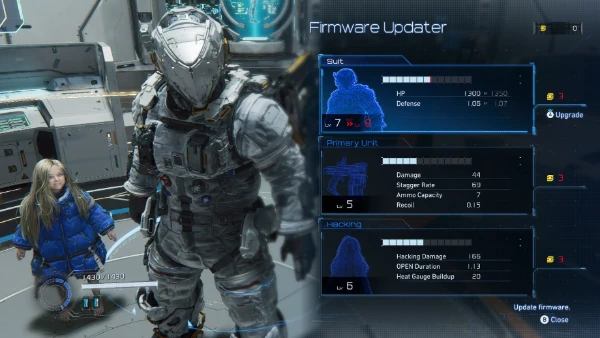
Between dangerous encounters, the Shelter provides an opportunity to recover and improve the characters’ capabilities. Resources collected during exploration, including Lunafilament, support upgrades to weapons and other useful equipment. Players can strengthen their preferred approach to combat, increase their available tactical options and prepare for more difficult opposition. This creates a satisfying connection between exploration and fighting: collecting materials is worthwhile because the improvements can make future encounters easier to manage. The Shelter also offers a quieter setting in which the relationship between Hugh and Diana can develop away from immediate danger. These intervals are important because the game’s demanding battles benefit from moments when players can recover, reassess their equipment and consider what they have learned.
Pragmata was released on 17 April 2026 for PlayStation 5, Xbox Series X|S and PC, with the Nintendo Switch 2 version also available from April, although launch dates differed in certain Asian territories. Its arrival marked the end of a lengthy development period following the original announcement in 2020. Before release, Capcom introduced players to its central mechanics through the free Pragmata Sketchbook demonstration, allowing them to experience the unusual combination of hacking and shooting. The completed game offers a single-player adventure rather than a competitive multiplayer experience. Its emphasis is on a designed sequence of encounters, character development and increasingly demanding combat situations, supported by upgrades and optional challenges.
The game’s commercial performance demonstrated considerable interest in a completely new Capcom property. On 7 May 2026, the publisher confirmed that Pragmata had sold more than two million copies worldwide within its first 16 days on sale. Critical reception was generally positive, with particular praise directed at the combat mechanics, visual presentation and relationship between Hugh and Diana. Reviews also identified limitations, including a relatively short main campaign, occasional repetition in enemy encounters and story elements that could have received greater development. These observations help establish realistic expectations. Pragmata is not designed as an enormous role-playing adventure with hundreds of hours of exploration; its strengths are concentrated in tightly constructed encounters and the unusual cooperation between its protagonists.
What ultimately distinguishes Pragmata is the way Capcom connects its individual ideas. Hacking is not a separate puzzle mode inserted between shooting sections, and Diana is not simply a companion who follows the protagonist through the story. Her abilities determine how battles unfold, while Hugh’s actions allow her interventions to produce meaningful results. The lunar facility provides a convincing setting for this cooperation, and the questions surrounding artificial intelligence give their relationship additional significance. The game is not without shortcomings, particularly for players seeking extensive exploration or a much longer campaign. However, its approach demonstrates that a third-person action game can introduce meaningful strategic decisions without becoming excessively complicated. Pragmata succeeds in making two very different characters, and two different styles of gameplay, feel like essential parts of the same adventure.
Capcom’s Pragmata takes a familiar idea – surviving inside a …

Mobile game monetisation in 2026 is no longer neatly divided …