
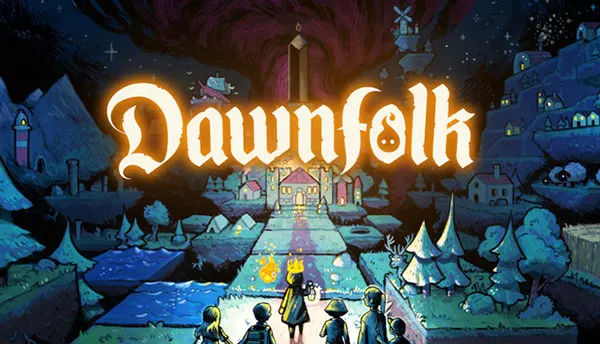
Dawnfolk arrived on Android and iOS on 17 August 2026, bringing Darenn Keller’s compact survival city builder to phones and tablets after its earlier PC and Nintendo Switch releases. The mobile version keeps the game’s unusual combination of city management, resource planning, small arcade-style challenges and a dark fantasy story centred on rebuilding a kingdom consumed by shadow. Short Circuit Studio handled the mobile conversion and publishing, while the basic design remains focused on short, manageable scenarios rather than the sprawling maps and complicated menus associated with many traditional city builders. That approach makes Dawnfolk especially relevant on mobile: settlements are built one tile at a time, most information is visible directly on the map, and a city can grow from a few basic structures into a sizeable settlement without demanding hours of uninterrupted play. As of 27 August 2026, both mobile versions are available, and several launch-week updates have already addressed stability, landscape orientation and controller-related issues.
Dawnfolk began as the work of solo developer Darenn Keller, who previously worked as a game designer at Ubisoft Bordeaux on projects including Ghost Recon and Assassin’s Creed. The commercial game was released for PC in February 2025 after growing from an earlier 64×64-pixel game-jam project called Lueur. That origin still influences the finished design. Instead of presenting a large simulated metropolis full of separate menus, traffic systems and detailed production chains, Dawnfolk represents its world as a clear grid of square tiles. Individual areas contain terrain, resources, structures or dangers, so the condition of a settlement can usually be understood by looking at the map rather than repeatedly moving between management screens.
The story provides a straightforward reason for this compact design. Enormous obsidian monoliths fell from the sky decades before the events of the game, spreading darkness across the kingdom and forcing its inhabitants from their homes. The player controls the ruler attempting to reclaim those lands with the help of Lueur, a small fiery creature capable of pushing back the darkness. Expansion therefore means more than simply placing another building. New territory must first be made safe, after which it can support homes, farms, resource production or specialised structures. The advancing settlement gradually replaces black, inaccessible parts of the map with productive land, making progress visually easy to follow even on a smaller screen.
This is still a strategy game rather than a passive building simulation. Expanding too quickly can create shortages, while concentrating exclusively on production can leave the settlement poorly prepared for later threats. Dawnfolk keeps the number of major resources deliberately limited, but those resources depend on one another enough to make placement and timing important. The result sits somewhere between city builder and puzzle game. The player is normally solving an immediate problem — insufficient food, limited workforce, a lack of construction materials or an approaching darkness threat — rather than administering dozens of statistical categories. On mobile, that narrower focus helps keep decisions understandable without stripping away the need to plan several moves ahead.
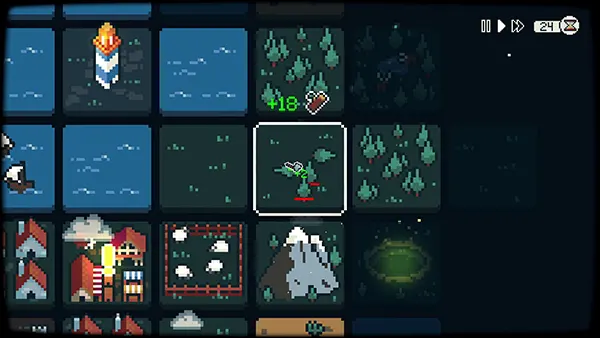
The square-tile map is one of the main reasons Dawnfolk transfers naturally to a touchscreen. A tile generally represents one meaningful decision: claim territory, place a structure, collect something or deal with a danger. There is less need for the rapid camera movement, tiny interface buttons or multi-layered construction menus that can make desktop strategy games awkward on phones. Buildings are also represented by distinctive pixel-art shapes, while darkness creates a strong visual boundary around usable land. Even as a settlement grows, the screen remains comparatively easy to read because the game communicates most of its important information through tiles and a limited collection of resource indicators.
Dawnfolk currently plays in landscape orientation on mobile. This gives the map more horizontal room and leaves space for the surrounding interface without compressing the central settlement into a narrow area. The first mobile builds did have some orientation-related problems, particularly when a phone was connected to certain controllers, but Short Circuit Studio responded with patches during the first week of release. An update also moved the mini-game camera closer to the bottom of the screen, showing that the mobile edition is receiving interface adjustments rather than simply remaining unchanged after launch. These details matter because small positioning problems are far more noticeable when a strategy game is played on a phone rather than a monitor.
The structure of individual scenarios also fits mobile use. Dawnfolk was designed around relatively short sessions, and its developer describes the progression from a tiny group of tents to a substantial city as something that can happen in less than an hour. That does not mean the whole game is short. The original developer estimates roughly six to ten hours for the main story, considerably more when side content and additional objectives are included, but the time is divided between self-contained maps and challenges. A player can therefore finish a meaningful piece of progress without committing to the type of multi-hour session often associated with larger strategy games. Phones do not change this structure; they simply make its existing session length more convenient.
At the centre of Dawnfolk are four broad resource areas: Light, Workforce, Food and Materials. Materials are needed to build, food supports the population, workforce allows the settlement to operate, and Light has a special role in reclaiming territory and resisting the darkness. Keeping these elements in balance creates most of the game’s economic pressure. More workers can increase what a settlement is capable of producing, but those people also need food. New production structures may require materials and workforce before they begin helping the economy. Expansion can provide valuable new land, yet spending too much Light on additional territory can leave fewer reserves available when darkness becomes a more immediate threat.
Terrain also affects what can be built and how efficiently a settlement develops. Forests, open land, mountains, water and other tile types create different opportunities, while some buildings interact with nearby structures. A farm placed in a useful agricultural area can strengthen food production, for example, while certain support buildings improve surrounding homes or other parts of the local economy. This adjacency system gives the small map more importance than its appearance initially suggests. Placing a structure on the first available square may solve an immediate shortage, but arranging related buildings more carefully can produce a stronger settlement with the same amount of territory.
Light is the resource that most clearly separates Dawnfolk from a conventional town-building game. Much of each map begins hidden or unusable beneath darkness, and Light allows the player to push that boundary outward. Darkness can also return as an active danger through storms and other threats, creating pressure to maintain reserves instead of spending everything on expansion. This gives the game a repeating rhythm: stabilise the settlement, produce enough resources, claim useful territory, strengthen production and prepare for the next problem. Because the system is based on a few visible values rather than an enormous economic model, it remains understandable on a mobile screen while still forcing the player to decide what can safely be spent.
Dawnfolk interrupts its slower city-management sections with very small arcade-style mini-games. Actions such as gathering resources, hunting or dealing with hostile creatures can trigger a brief skill challenge inside an individual tile. Examples in the game include timing-based chopping, firing at moving animals and defensive sequences in which attacks must be blocked or avoided. These sequences usually last only a few seconds. They are not separate game modes loaded from another menu; they appear as part of ordinary resource collection and map activity, so the shift between planning a settlement and carrying out a direct action happens quickly.
Performance in these mini-games can affect the amount of resources gained, which creates a link between the player’s actions and the wider settlement economy. A successful attempt may give the city a better return, while weaker performance can make a shortage harder to solve. At the same time, Dawnfolk does not require every repetitive task to remain manual forever. Progress can provide ways to automate certain activities, allowing attention to return to city planning once the player no longer wants to repeat the same small challenge. That matters over longer sessions because a mechanic that feels entertaining several times can become distracting if it interrupts every routine action indefinitely.
On a phone, these short interactions make more sense than replacing the city-building layer with complex real-time combat. The player still spends most of the session thinking about resources, positioning and expansion, but occasionally has to perform a direct task that can be completed in seconds. It adds variation without turning Dawnfolk into an action game. Players who prefer completely passive resource collection may find the early repetition less appealing, whereas those who like a small amount of manual interaction receive something to do between planning decisions. The important distinction is that the mini-games support the resource system rather than becoming the main objective.
The public Android and iOS release took place on 17 August 2026, with Short Circuit Studio responsible for porting and handling the mobile edition. The purchasing model currently differs slightly between the two major stores. On iOS, Dawnfolk can be installed without an initial payment, and the full game is available through a one-time purchase. The UK App Store currently lists that unlock at £7.99, while the US listing shows $7.99. The developer has also clarified that this purchase model keeps the game free from advertising. Google Play currently presents Dawnfolk as a paid game; the US listing checked in August 2026 shows a price of $7.99. Store prices can vary by country, taxation and local currency, so the amount shown directly on a device should be treated as the final local price.
The mobile edition is still very new, and the first updates have concentrated on practical problems rather than adding major new systems. On iOS, launch-week patches addressed landscape behaviour, the position of the mini-game view, stability and controller support. This is useful context for anyone comparing early user comments with the current build because some problems reported immediately after release have already received fixes. The App Store also lists Game Center support, while the current iOS download is roughly 349 MB before any later changes to the installation package. Storage requirements and version numbers can change as additional updates are released, so these figures are best treated as a snapshot of late August 2026 rather than permanent specifications.
The amount of content is broader than the minimalist presentation may suggest. Dawnfolk includes a story campaign alongside Puzzle scenarios, Curious Expeditions, Sandbox and Endless play. Different scenarios adjust objectives and restrictions rather than simply presenting a larger version of the same map. Puzzle content places more emphasis on making efficient use of limited space, while Curious Expeditions modify normal rules or introduce unusual conditions. Sandbox reduces some of the survival pressure, and Endless play is built around keeping a settlement alive as difficulty continues to rise. The game also supports different approaches to pacing, including real-time and turn-based options, as well as adjustable difficulty in relevant modes.
Dawnfolk is most likely to suit players who want city-building decisions without the administrative weight of a large simulation. It still asks the player to manage shortages, position buildings, react to threats and think about long-term resource use, but it avoids filling the screen with dozens of production graphs and nested menus. That makes it easier to resume after putting the phone away for a while because the state of the settlement can be understood comparatively quickly. The short scenario format also gives each session a defined purpose instead of expecting one enormous city to remain active for weeks or months.
Its minimalism also creates clear limits. Anyone mainly interested in detailed transport networks, individual citizen simulation, complex trade systems or huge industrial chains will find Dawnfolk deliberately smaller in scope. The challenge comes from making efficient decisions with a compact set of systems rather than mastering a giant economy. Mini-games can also become repetitive for players who want uninterrupted strategic planning, although later automation reduces that issue. Endless mode pushes the survival side more heavily and can become increasingly demanding, while the campaign and shorter scenario types tend to fit the game’s compact design more naturally.
As a mobile conversion, Dawnfolk works because the original game was already built around readable tiles, short scenarios, restrained menus and gamepad-friendly interaction. Android and iOS do not require the core design to be simplified into a different game; instead, the existing structure is condensed into a device that suits its session length. The early updates show that Short Circuit Studio is still refining mobile-specific behaviour, so small interface details may continue to change after August 2026. What remains consistent is the underlying idea: rebuild a threatened kingdom one tile at a time, maintain a small but interconnected economy, use Light carefully and solve each scenario without the heavy learning curve normally associated with much larger city-building games.

Mobile game monetisation in 2026 is no longer neatly divided …
CloverPit turns one of gambling’s most familiar machines into the …