
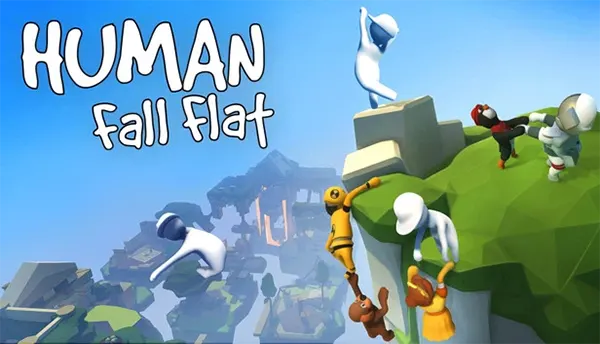
Human: Fall Flat has stayed relevant for years because it doesn’t rely on novelty alone — it relies on a simple idea executed well: a physics-driven puzzle world where mistakes are part of the solution. In 2026, the game is still actively supported with free official level updates and remains widely played in co-op. That makes it a practical choice for people who want a light puzzle experience with friends, but it also raises a fair question: is it actually comfortable to play, or does the “wobbly” design become annoying in real sessions?
The first thing to understand is that Human: Fall Flat is not built around precise movement. Your character’s arms, grip, and balance are deliberately awkward, which means the game can feel “unfair” if you expect traditional platformer accuracy. In practice, though, this awkwardness is the core mechanic — it forces you to think creatively. Instead of executing perfect jumps, you solve problems by grabbing objects, bracing yourself, and using momentum. Comfort comes when you stop fighting the physics and start working with it.
In longer play sessions, the controls become much more predictable than they seem at the beginning. Players usually improve quickly once they learn two things: move the camera first so you can judge distance properly, and use controlled arm movement rather than frantic grabbing. Once those habits become automatic, the character starts to feel like a physical tool rather than a chaotic puppet. That’s when the puzzles become satisfying rather than exhausting.
By 2026, the amount of official content also helps with comfort, because you have more space to learn naturally. The game continues to expand through free updates, and recent official patch information has referred to at least 29 official levels, with more still planned. More levels means more practice with different obstacle styles — climbing, swinging, balancing, transporting objects — without repeating the same early stages too often.
Camera behaviour is often the biggest comfort barrier for new players. Human: Fall Flat frequently places you in vertical spaces — cliffs, towers, suspended bridges — where depth perception matters. In solo play you can take your time, reposition, and test angles until grabbing feels reliable. In co-op, however, people tend to rush, which makes the camera feel more stressful because you’re reacting to group movement rather than controlling the pace yourself.
Readability also depends on the screen setup. On a large display, judging distances and object placement feels easier. On smaller screens, you may need extra time to line up climbs and grabs. The game is not a fast reaction experience, so most comfort issues can be solved simply by slowing down and treating tricky parts as “engineering,” not as action sequences.
Motion comfort is usually better than in many modern games because the pace is self-directed — there are few sections that force rapid camera swings. When discomfort happens, it’s usually because multiple players tug on the same object at once, causing sudden camera shifts and unpredictable movement. A simple teamwork rule improves comfort immediately: assign roles instead of everyone grabbing everything at the same time.
Human: Fall Flat works especially well in co-op because many puzzles naturally encourage cooperation. Doors are heavy, buttons are far apart, and objects often need to be stabilised while someone climbs or jumps. Even when a level is solvable alone, co-op makes it feel more natural — one player can hold a platform steady while another makes the risky move.
In 2026, online multiplayer remains one of the game’s strongest selling points. Official and widely cited co-op information states that the online mode supports up to eight players. That opens the door to larger social sessions, but it also changes comfort dramatically: the more players you have, the more accidental interference happens. Someone will bump the crate you carefully positioned, or pull a lever too early. That doesn’t ruin the game — it just shifts it toward comedy and improvisation rather than calm puzzle solving.
From a comfort perspective, the “sweet spot” for most groups is two to four players. It keeps coordination manageable while still giving you enough helping hands for heavy objects, long jumps, and multi-step puzzles. If your goal is steady progression, smaller groups feel smoother. If your goal is laughter and unpredictable outcomes, eight-player sessions deliver exactly that, but the comfort level becomes less consistent.
Local co-op generally feels more comfortable because communication is instant and the flow is calmer. You can coordinate without voice delay, and you can learn faster by watching how the other player solves a movement problem. Many sources describe local play as two players on one device, which aligns well with the game’s design: two players can cooperate without turning every puzzle into a crowd scene.
Online co-op comfort depends heavily on connection stability. Physics-based games are sensitive to small delays — a grab that feels perfectly timed on your side might register slightly late when the host updates the position of your character. With friends on stable connections, this usually isn’t a major issue, but with random lobbies it can occasionally make climbing and swinging feel less reliable.
The advantage of online play is flexibility. People can join and leave sessions more easily, and larger friend groups can play together without needing to meet in person. That makes the game an easy fit for casual evenings in 2026, especially because failure doesn’t carry heavy penalties — you restart quickly, and most mistakes become part of the fun rather than a reason to quit.
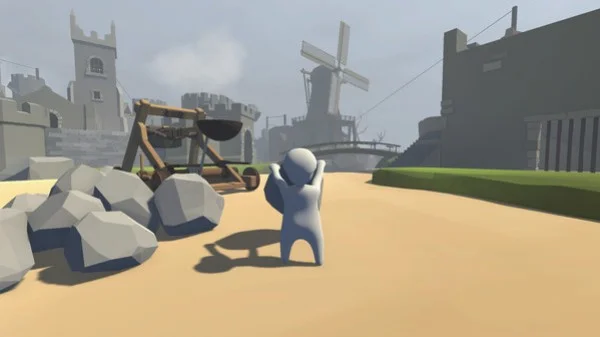
Human: Fall Flat remains relevant in 2026 largely because the developers continue to release official levels as free updates. One example covered in official publisher news is the “Hike” level, described as a mountain-themed map focused on climbing, traversal puzzles, and teamwork. Free official level releases like this keep the game fresh and encourage players to return, even if they’ve already completed the earlier stages.
Another reason it holds up is that it’s not demanding in terms of hardware, which makes it comfortable across different systems. Because the gameplay is based on physics interaction rather than high-speed combat, controller play feels natural, and the learning curve is more about understanding movement than mastering complex button combos. That’s a major comfort advantage for mixed groups where not everyone plays games regularly.
Looking at the wider context of 2026, the game is also being positioned for new hardware audiences. Publisher announcements and multiple media reports have discussed a Nintendo Switch 2 Edition planned for spring 2026, which is a clear sign the game is still being actively supported and marketed as relevant. Even if you don’t plan to move devices, that continued attention suggests the game’s future is not “frozen in time.”
Human: Fall Flat is comfortable for players who enjoy experimentation and don’t mind failing a few times while learning. The controls can feel clumsy at first, but they are consistent once you understand the logic: balance is fragile, arms behave like real weight, and momentum matters. That consistency is what makes the game fair — it’s not random, it just behaves differently than a traditional platformer.
Players who want strict precision may find the game frustrating, especially during climbs or object stacking. However, many of those moments become easier with co-op, because another player can stabilise objects, rescue you from falls, or simply provide an alternate solution. In that sense, comfort improves not by improving the character — but by improving teamwork.
In 2026, the practical verdict is that the game remains a strong co-op choice if your group values light puzzle solving mixed with humour. It’s most comfortable in small teams, it becomes chaotic in large online sessions, and it stays fresh because official free levels continue to expand the experience. If you accept the physics as part of the challenge, Human: Fall Flat is still one of the easiest co-op games to recommend for casual play sessions.
The Game of Thrones universe has always attracted developers aiming …

Digital distribution has changed how players buy and store video …