
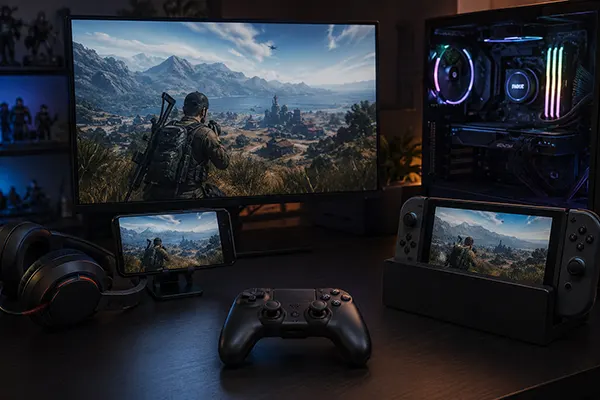
Cross-play has become a standard feature in modern multiplayer gaming by 2026. Players no longer expect to stay locked inside a single ecosystem, whether they use a gaming PC, a PlayStation console, an Xbox device, a Nintendo handheld, or a smartphone. The ability to continue progression on different devices and join the same matches with friends regardless of hardware has changed player behaviour across competitive and casual games alike. At the same time, developers continue to face difficult technical and balancing challenges linked to matchmaking systems, control methods, anti-cheat protection, and server synchronisation. What originally appeared to be a simple convenience feature has now become one of the most debated mechanics in online gaming.
The gaming market in 2026 is heavily shaped by multi-device usage. A significant number of players switch between PC, console, and mobile gaming during the same week. Someone may complete battle pass tasks on a smartphone during travel, continue ranked matches on a console in the evening, and later access the same account from a gaming computer. Publishers recognised that restricting players to a single device ecosystem reduced long-term engagement and weakened online communities.
Cross-play also solved population problems inside multiplayer titles. Several games released between 2020 and 2024 suffered from shrinking player counts because communities were split between separate hardware environments. Combining these pools dramatically improved queue times in shooters, sports simulators, racing games, and co-operative action titles. In 2026, many publishers treat cross-play as a necessary launch feature rather than an optional addition.
Another important factor is social interaction. Friends often own different hardware, especially in regions where consoles remain expensive or where mobile gaming dominates. Cross-play removes these barriers and allows communities to remain active without forcing players to purchase specific systems. Titles such as Fortnite, Call of Duty, Minecraft, Rocket League, EA Sports FC, and Genshin Impact helped normalise this expectation among millions of users worldwide.
Cross-progression became just as important as cross-play itself. Modern players expect their unlocks, cosmetic items, achievements, and account progression to move freely between devices. In 2026, account ecosystems connected through publishers like Ubisoft, Riot Games, Epic Games, Microsoft, and Sony allow users to continue their activity without restarting progress from scratch.
This shift created stronger long-term retention for publishers because users became less dependent on one device. A player who upgrades from console to PC no longer loses years of progression. The same principle applies to mobile integrations, where companion apps and cloud gaming systems increasingly support account synchronisation across different hardware types.
However, cross-progression also created new risks linked to account theft and security. Shared ecosystems mean that compromised login credentials may affect multiple devices simultaneously. As a result, two-factor authentication, biometric login systems, and hardware-based security verification became more common across large gaming services during 2025 and 2026.
One of the largest debates surrounding cross-play concerns control methods. PC players using a mouse and keyboard often have faster aiming precision compared to console users relying on gamepads. Mobile players face additional disadvantages due to touchscreen controls, smaller displays, and inconsistent network conditions. These differences directly influence competitive integrity.
Developers attempted to solve this issue through input-based matchmaking systems. Instead of grouping users purely by hardware, many games now separate players according to active control methods. A console player using a keyboard may enter PC-oriented matchmaking pools, while PC users connecting gamepads can sometimes join controller-based lobbies. Despite these efforts, balancing remains controversial in highly competitive games.
Aim assist mechanics continue to generate intense discussions within shooter communities. Console players often receive stronger aim correction to compensate for joystick limitations, but PC users frequently argue that modern aim assist systems became too aggressive. In several competitive titles during 2025 and 2026, professional players publicly criticised inconsistent balancing between mouse precision and controller tracking systems.
Modern matchmaking systems no longer analyse only player skill ratings. By 2026, developers also consider hardware performance, frame rates, latency stability, regional routing, active input devices, and behavioural data. Cross-play environments forced studios to redesign ranking systems because equal skill does not always produce equal gameplay conditions.
Performance differences remain significant between devices. A high-end gaming PC running at 240 FPS may provide smoother reaction times compared to a console locked at lower frame rates. Mobile devices create additional variation because hardware specifications differ widely between budget phones and premium gaming smartphones. Some competitive games now display optional indicators showing input type or hardware category inside matchmaking lobbies.
Publishers also began introducing selective cross-play filters. Players can disable mixed-platform matchmaking in certain ranked modes while keeping it active for casual playlists. This approach attempts to satisfy both competitive users seeking balanced conditions and casual players prioritising accessibility and shorter queue times.

Cheating remains one of the most serious problems connected to cross-play environments. PC gaming traditionally experiences higher levels of software-based cheating, including wallhacks, aim automation, recoil scripts, and packet manipulation tools. Console ecosystems were historically more protected due to hardware restrictions, but unified matchmaking increased concerns among console communities.
In response, publishers invested heavily in anti-cheat technology between 2024 and 2026. Kernel-level anti-cheat systems became more widespread despite privacy debates, while machine-learning behavioural analysis tools improved cheat detection accuracy. Several major developers also introduced real-time account trust scoring that evaluates suspicious behaviour patterns across all connected devices.
Mobile cheating expanded as well, particularly through emulator usage and modified Android applications. Developers now actively detect emulator-based matchmaking abuse and frequently separate emulator users from native mobile players. This became especially important in competitive mobile shooters and battle royale titles where external software could create unfair advantages.
Cross-play is unlikely to disappear because player expectations have fundamentally changed. The convenience of unified ecosystems, shared progression, and flexible device access now represents a core part of modern multiplayer gaming. Publishers that ignore these expectations risk losing long-term audience engagement, especially among younger players accustomed to switching devices constantly.
Future improvements will likely focus on smarter matchmaking systems and more advanced anti-cheat technologies. Artificial intelligence is already being used to identify suspicious gameplay behaviour, unusual movement patterns, and impossible reaction times. Cloud gaming infrastructure may also reduce hardware gaps by moving performance processing away from local devices and into remote servers.
Despite ongoing balancing concerns, cross-play continues to strengthen gaming communities by removing technical barriers between players. The main challenge for developers in 2026 is no longer whether cross-play should exist, but how to create fair competitive environments while maintaining the convenience and accessibility that players now expect from every major multiplayer release.

CloverPit turns one of gambling’s most familiar machines into the …

Microgaming is widely recognised as one of the formative names …